skip to main |
skip to sidebar
In our home we celebrated each month of the year using its distinctive flower, fruit, dessert and dish. My mom always had fresh flowers in a vase on the big dining room table. Sweet smelling paper whites for my name day on January 18. Flowering brunches of almond tree and tulips in February, the first anemones and yellow mimosas in March, lilacs in April, ranunculus in May, lilies and roses in June, in July and part of August we were always away for the summer so we were not buying flowers. There were roses again in September, mums in October, pyracanthai in November and holly, evergreens and mistletoe in December. The mistletoe never lasted for long since I couldn’t resist crushing its soft white pearls and of course getting scolded for it. In time I had developed a strategy: crush a couple white pearls and wait until the first of the year to finish them all.
The food also varied according to the seasons. We ate milk fed lamb on Easter Sunday, and baby lamb chops only to early June. Lamb in the summer was considered “heavy” food, plus the lambs that were born in spring were no longer milk fed and tender. We ate game in the fall, pork during the cold months, fresh fish mostly from spring to fall and salt dried cod in the winter. Chicken and beef were cooked in various ways all year round. Also the fruits and vegetables followed the seasonal change. And every time we tasted the first fruit of a season we said: “ade keh to hronu”, an expression that means “may we be blessed to taste it again next year”. My favorite season was from May to September. May and June meant cherries and strawberries that my dad taught me to eat dipping them in sugar. The cherries I had to open in half and check for warms before I ate them. The same method applied to the aromatic and beautiful apricots. At the time there were not effective pesticides so we had to carefully inspect every fruit and vegetable before eating them. Mulberries offered instant gratification since for some peculiar reason they were free of warms, although they are the main food for the silk worms. My great aunt Efterpi had mulberry trees in her yard and when they were ready sometime in early June she would bring us two very small baskets filled one with white and the other with black mulberries. I could never make up my mind which ones I liked the best , so I would eat one of each trying to decide until I would finish them all.
July brought watermelons and also peaches with fuzzy skins that sometimes made me itch, but I ate them any way since they were juicy, sweet and aromatic. On hot summer nights instead of dinner we ate slices of watermelon together with feta cheese. A terrific combination of sweet and juicy with salty and dry or creamy cheese. Another variation to this light meal is feta and ripe melon. Absolutely delicious!
Tomatoes were also a late July fruit and sometimes I liked eating them, but most of the times I would hate them. Once my mom was trying to make me eat a tomato and I was stubbornly refusing to the point that she lost her temper and pressed the ripe fruit on to my face. Oh, well, childhood was not a bed of roses. And if it was so, even roses have thorns.
The reason I did not always like tomatoes is because their taste and texture was never predictable. The fruit vendors had total control of their merchandise, meaning that the buyer could not choose, so very often in a two pound bag of tomatoes they would put a couple of good ones on the top while the rest was either unripe or over ripe ones, good only for sauces. Very early in my life my parents started taking me along to the market place were they would teach me the secrets of choosing fresh and good quality ingredients for cooking. For example lemons and oranges should have their spot they were hanging from the tree green and fresh while their skin should be firm and thin. Meat should be freshly slaughtered and pink, fish should have pleasant smell, red gills and with sparkling, not cloudy eyes. The cheese should be tasted before purchase while coffee and exotic spices should be bought in small quantities so that they do not loose their aroma. The only fruit I do not know how to choose are the melons. They seem to be deceiving and mysterious and very often I make the wrong choice.
Winter was seemingly a boring season in every way. There were three kinds of fruit, apples that I did not like, oranges that were often too tart and bananas that were about three inches long but at least predictably sweet. As for vegetables there were potatoes, too starchy, cabbage, too smelly, leeks, the epitome of disgustingly slimy and stinky vegetable, carrots were ok though not exciting, celery root was good since it gave a distinctive flavor and aroma to the bean soup, and quince that though it is a fruit it is versatile enough to be cooked with pork in a sweet and sour combination. For a brief time around November chestnuts would make their appearance first at the street corners roasted on a makeshift coal stove and soon after on our potbelly wood stove. Chestnuts in the winter were the equivalent of ice cream in the summer. Since refrigerators were kind of rear, ice cream was sold and consumed only in the summer. I had a love and hate relation with it. I liked it very much but when I was very young I could not eat an ice cream cone fast enough, so I always ended up staining my little white dresses with chocolate, strawberry or cream. And I would get very upset to the point of refusing to eat ice cream at all unless it was served properly in a bowl with a spoon and a napkin. I also loved fresh fruits granita. I preferred strawberry to lemon. Once I must have been about 4 years old, my dad took me to an open-air movie theater to watch a movie with my favorite Greek actress, Alike Vougiouklaki. It was a lovely summer night; I was enjoying the film until at the intermission I noticed that they were selling strawberry granita in slim long glasses with striped paper straws. I asked for one, but my father absolutely refused to buy it using the excuse that they probably the glasses were not very clean. I am sure that he was right in his judgment and decision but I was terribly disappointed. To this day whenever I see granita I think of my dad and his fear of eating something unclean. Needless to say that having a hot dog was out of question, as was cotton candy, ice cold almonds and all street food that had been processed and handled. And as all rules have their exceptions, in this case the only street food permitted was roasted corn on the cob in the summer, and chestnuts in the winter, since there are no germs resisting the flames and the heat of coal.
 The first 7 years of my life I've spent them in Aristotelous street, in the center of Thessaloniki. We were living in an apartment that was surrounded by busy markets and historic buildings. Regardless to its prime location that apartment lacked essential conveniences such as hot water and a bath or shower. We used the kitchen sink for our daily grooming, but serious bathing was a big nuisance that took place once a week.
Saturday was usually the day we got ready for Sunday. Which meant clean the apartment and decorate the dining table with fresh flowers, buy all the provisions for an elaborate meal and also take a bath so we'd be ready for our Sunday best.
Taking a bath was a big production that required planning and preparation. We had two options: to set it up in the kitchen were my mom and grandma boiled hot water, set the laundry basin in lieu of a bath tub and brought all the necessary accoutrements such as soap, sponges, a big bucket for mixing hot and cold water, a pitcher for rinsing, towels, special wooden shoes to wear after the bath, clean clothes and of course a mop for cleaning the floor afterwards. That way bathing seized to be a pleasure, it was plain hard work.
The other, more delightful option was going to Hamam Paradisos, the Turkish Baths. In the mid 1950s there were at least 5 active Turkish baths in Thessaloniki. A Turkish bath is not only a place for bathing but also a great way to socialize in a leisurely environment. We always went in a group: I, my mom, my grandmother, her sister who's body was similar to the Venus of Milo plus the arms, my god mother, her mother in law, her sister in law and my god sister Mary, a happy party of eight.
We walked to the Hamam that was at the end of our street, odos Aristotelous. We carried our bags with clean clothes, towels, toiletries and the tasia, metal bowls with a concave middle that fit perfectly in the wet hands. We used them for throwing water on our bodies and for rinsing our hair. We also brought along some fruit and tea to revive us after hours of exposure to heat.
Sultan Murat II built the Hamam of our choice in 1444 at a time likely prior to the birth of Columbus. After 500+ years of continuous use as a public bath nowadays it has acquired the status of a monument.
My god sister Mary and I have recently visited Hamam Bey as it is now officially called. It looks dry, cold and somehow dead.
We have a different image of the place.
Upon entering through the Moorish door of the building we could smell the sweet aroma of soap and jasmine oil, and feel the excitement of the anticipation of playing with the warm water. After taking our clothes off and leaving them in wooden lockers we would walk into the first chamber, a bare place filled with sweet smelling steam that hid the naked bodies in a warm fog. From there passing through a small marble threshold we could finally enter the paradisiacal room with the marble alcoves and the round center under the big domed ceiling. As you entered that space the first thing you noticed was the sound of the water coming endlessly out of about a dozen bronze faucets that kept the marble alcoves filled with warm water. Steam was rising up to the dome that had colored windows in the shape of stars. From there we could see shafts of light penetrating the mist and creating a magical ambience.
Mary and I always managed to escape the attention of our relatives and run around splashing each other and dipping our selves in the other bather's alcoves. We were often scolded but nevertheless we always managed to amuse ourselves.
There were adjacent rooms: one with extreme heat that I was never allowed to walk in and another one smaller that had a marble bed in its middle. That was the domain of a big menacing looking woman with a mustache, who gave massages. We liked to pick through the threshold and get ourselves scared watching her rubbing the naked bodies till they turned red and sometimes using a long brush made out of horsehair flaying their skin to improve the circulation.
We stopped going to the Hamam once we moved to another apartment that finally had hot water and a bathroom. Now we could bathe in privacy whenever we wanted but we were missing the fun and magical atmosphere of the Turkish Baths.
By the mid 1970s all the Hamams in Thessaloniki were closed.
But I was lucky enough to go two more times to the Turkish baths.
In the summer of 1983, my husband and I were on a 50day honeymoon. One of the places we visited was the town of Rodes, in Greece. My friend, our host who was native to the island, treated me to a Turkish bath. The Bath was in a small building divided in a man's and a women's part and was used regularly by the remaining turkish population of the town of Rodes. The women's baths were modest domed rooms, divided in tepid, hot and unbearably hot spaces. My friend and I walked in bare, wearing only the wooden clogs they gave us at the entrance, that were similar to the ones we used in my childhood. A wood platform like a japanese shoe with a horizontal top band made out of a black rubber strip cut form a recycled tire The rooms were steamy and fogy, and since I could not wear my glasses the whole place looked dreamy and bleary. I remember 3 things: the beams of light coming from the star shaped holes on the dome with golden particles dancing in the mist. The muslim women who were rushing to hand me back my soap that had fallen on the ground telling me to be careful not to slip and fall (I was 6 months pregnant), and the poetic image of a mother with her 5 year old son, draped into her arms in a languid abandon, almost like a Pieta.
Apparently boys up to the age of 7 are permitted into this strictly feminine world.
The last time I went to a Turkish bath, was in Paris in June of 1989. My friend Francoise and her girlfriend of that time went to the Hamam de la Mosqee, on the Left Bank. The building is big and impressive, a slice of Arabia in the heart of Paris. We chose a day that was open to the women only. We walked passed the big gate door into the atrium and from there we entered the secret franco-arabian world. The Hamam, the only place of the Mosqee open to non muslims, was covered with wooden panels painted with birds and plants, all in greens, reds and blues. The light was dim, this time I was wearing contacts and no detail was going to be lost. When we bought our tickets, the cashier asked us if we had "le gant noir"- the black glove. We hurried to purchase one for each one of us for the sum of few francs and as we found out later it was one of the most useful purchases. The black glove was a small washcloth, like a pocket made out of a rough black damask fabric that was perfect for exfoliating the skin. We left our clothes in one of the painted cabinets and walked into a very big marble room, full of steam and Maroccan and Algerian women of all ages. We sat on a marble bench and with a plastic bottle cut in half started the cleaning ritual. Apparently we were not supposed to use soap at the beginning, but with the help of the black glove and hot water we worked the dead cells off our skin. Once our skin was polished, we lathered ourselves with soap. We stayed for at least two hours, exfoliating, massaging, soaping and rinsing, getting overwhelmed by the heat of the steam and the waters. And at the same we gossiped, laughed and told stories. By the time we ended wrapped in big towels on the soft mats on the "recovery room" under the painted cabinets, we were exhausted but sparkling clean, with rosy cheeks. Also our heads were empty of worries and preoccupations and we were in a euphoric state. After we found the strength to get dressed, we walked through a colored glass double door into the teahouse where we were revived by freshly made mint tea and maroccan pastries. The teahouse is lavishly decorated in a fashion straight out of the 1001 nights. When we walked out of this magical world my French friends confessed that they had never thought that taking a bath could be so demanding and so much fun!
The first 7 years of my life I've spent them in Aristotelous street, in the center of Thessaloniki. We were living in an apartment that was surrounded by busy markets and historic buildings. Regardless to its prime location that apartment lacked essential conveniences such as hot water and a bath or shower. We used the kitchen sink for our daily grooming, but serious bathing was a big nuisance that took place once a week.
Saturday was usually the day we got ready for Sunday. Which meant clean the apartment and decorate the dining table with fresh flowers, buy all the provisions for an elaborate meal and also take a bath so we'd be ready for our Sunday best.
Taking a bath was a big production that required planning and preparation. We had two options: to set it up in the kitchen were my mom and grandma boiled hot water, set the laundry basin in lieu of a bath tub and brought all the necessary accoutrements such as soap, sponges, a big bucket for mixing hot and cold water, a pitcher for rinsing, towels, special wooden shoes to wear after the bath, clean clothes and of course a mop for cleaning the floor afterwards. That way bathing seized to be a pleasure, it was plain hard work.
The other, more delightful option was going to Hamam Paradisos, the Turkish Baths. In the mid 1950s there were at least 5 active Turkish baths in Thessaloniki. A Turkish bath is not only a place for bathing but also a great way to socialize in a leisurely environment. We always went in a group: I, my mom, my grandmother, her sister who's body was similar to the Venus of Milo plus the arms, my god mother, her mother in law, her sister in law and my god sister Mary, a happy party of eight.
We walked to the Hamam that was at the end of our street, odos Aristotelous. We carried our bags with clean clothes, towels, toiletries and the tasia, metal bowls with a concave middle that fit perfectly in the wet hands. We used them for throwing water on our bodies and for rinsing our hair. We also brought along some fruit and tea to revive us after hours of exposure to heat.
Sultan Murat II built the Hamam of our choice in 1444 at a time likely prior to the birth of Columbus. After 500+ years of continuous use as a public bath nowadays it has acquired the status of a monument.
My god sister Mary and I have recently visited Hamam Bey as it is now officially called. It looks dry, cold and somehow dead.
We have a different image of the place.
Upon entering through the Moorish door of the building we could smell the sweet aroma of soap and jasmine oil, and feel the excitement of the anticipation of playing with the warm water. After taking our clothes off and leaving them in wooden lockers we would walk into the first chamber, a bare place filled with sweet smelling steam that hid the naked bodies in a warm fog. From there passing through a small marble threshold we could finally enter the paradisiacal room with the marble alcoves and the round center under the big domed ceiling. As you entered that space the first thing you noticed was the sound of the water coming endlessly out of about a dozen bronze faucets that kept the marble alcoves filled with warm water. Steam was rising up to the dome that had colored windows in the shape of stars. From there we could see shafts of light penetrating the mist and creating a magical ambience.
Mary and I always managed to escape the attention of our relatives and run around splashing each other and dipping our selves in the other bather's alcoves. We were often scolded but nevertheless we always managed to amuse ourselves.
There were adjacent rooms: one with extreme heat that I was never allowed to walk in and another one smaller that had a marble bed in its middle. That was the domain of a big menacing looking woman with a mustache, who gave massages. We liked to pick through the threshold and get ourselves scared watching her rubbing the naked bodies till they turned red and sometimes using a long brush made out of horsehair flaying their skin to improve the circulation.
We stopped going to the Hamam once we moved to another apartment that finally had hot water and a bathroom. Now we could bathe in privacy whenever we wanted but we were missing the fun and magical atmosphere of the Turkish Baths.
By the mid 1970s all the Hamams in Thessaloniki were closed.
But I was lucky enough to go two more times to the Turkish baths.
In the summer of 1983, my husband and I were on a 50day honeymoon. One of the places we visited was the town of Rodes, in Greece. My friend, our host who was native to the island, treated me to a Turkish bath. The Bath was in a small building divided in a man's and a women's part and was used regularly by the remaining turkish population of the town of Rodes. The women's baths were modest domed rooms, divided in tepid, hot and unbearably hot spaces. My friend and I walked in bare, wearing only the wooden clogs they gave us at the entrance, that were similar to the ones we used in my childhood. A wood platform like a japanese shoe with a horizontal top band made out of a black rubber strip cut form a recycled tire The rooms were steamy and fogy, and since I could not wear my glasses the whole place looked dreamy and bleary. I remember 3 things: the beams of light coming from the star shaped holes on the dome with golden particles dancing in the mist. The muslim women who were rushing to hand me back my soap that had fallen on the ground telling me to be careful not to slip and fall (I was 6 months pregnant), and the poetic image of a mother with her 5 year old son, draped into her arms in a languid abandon, almost like a Pieta.
Apparently boys up to the age of 7 are permitted into this strictly feminine world.
The last time I went to a Turkish bath, was in Paris in June of 1989. My friend Francoise and her girlfriend of that time went to the Hamam de la Mosqee, on the Left Bank. The building is big and impressive, a slice of Arabia in the heart of Paris. We chose a day that was open to the women only. We walked passed the big gate door into the atrium and from there we entered the secret franco-arabian world. The Hamam, the only place of the Mosqee open to non muslims, was covered with wooden panels painted with birds and plants, all in greens, reds and blues. The light was dim, this time I was wearing contacts and no detail was going to be lost. When we bought our tickets, the cashier asked us if we had "le gant noir"- the black glove. We hurried to purchase one for each one of us for the sum of few francs and as we found out later it was one of the most useful purchases. The black glove was a small washcloth, like a pocket made out of a rough black damask fabric that was perfect for exfoliating the skin. We left our clothes in one of the painted cabinets and walked into a very big marble room, full of steam and Maroccan and Algerian women of all ages. We sat on a marble bench and with a plastic bottle cut in half started the cleaning ritual. Apparently we were not supposed to use soap at the beginning, but with the help of the black glove and hot water we worked the dead cells off our skin. Once our skin was polished, we lathered ourselves with soap. We stayed for at least two hours, exfoliating, massaging, soaping and rinsing, getting overwhelmed by the heat of the steam and the waters. And at the same we gossiped, laughed and told stories. By the time we ended wrapped in big towels on the soft mats on the "recovery room" under the painted cabinets, we were exhausted but sparkling clean, with rosy cheeks. Also our heads were empty of worries and preoccupations and we were in a euphoric state. After we found the strength to get dressed, we walked through a colored glass double door into the teahouse where we were revived by freshly made mint tea and maroccan pastries. The teahouse is lavishly decorated in a fashion straight out of the 1001 nights. When we walked out of this magical world my French friends confessed that they had never thought that taking a bath could be so demanding and so much fun!
Since mom's health got established I felt it was ok to take another short trip to Kastoria to spend the great festivities of Dekapentaugoustos.
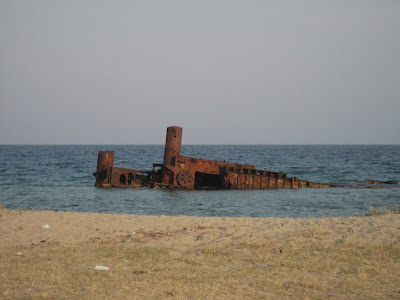 The shipwreck, a magical place, a 45' drive from the center of Thessaloniki. Great beach, open sea and this old boat like a reclining dinosaur sunk in the shallow waters.


 The first 7 years of my life I've spent them in Aristotelous street, in the center of Thessaloniki. We were living in an apartment that was surrounded by busy markets and historic buildings. Regardless to its prime location that apartment lacked essential conveniences such as hot water and a bath or shower. We used the kitchen sink for our daily grooming, but serious bathing was a big nuisance that took place once a week.
 The shipwreck, a magical place, a 45' drive from the center of Thessaloniki. Great beach, open sea and this old boat like a reclining dinosaur sunk in the shallow waters.